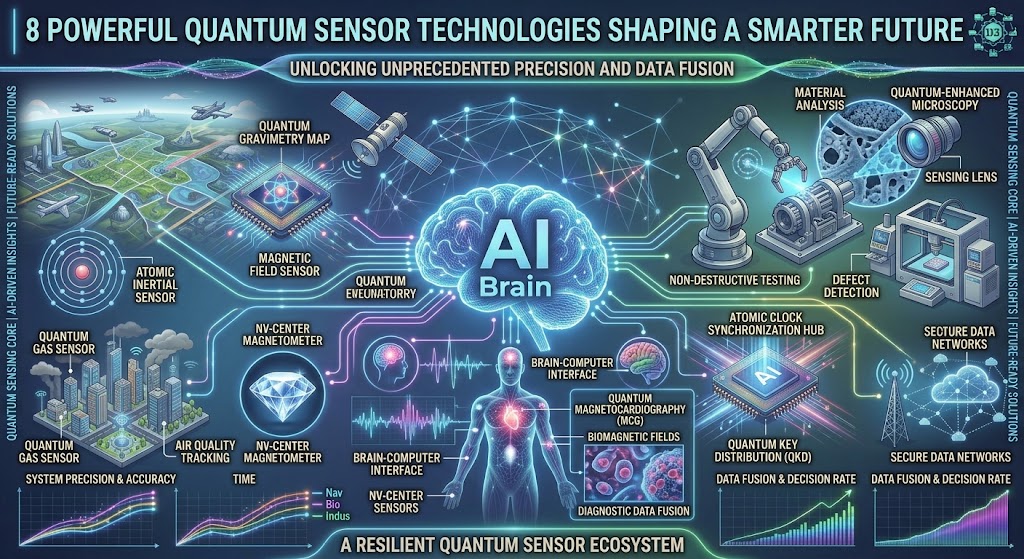
Quantum Sensor Technologies are opening a new era of highly sensitive measurement by using unique properties of quantum physics to detect changes that conventional sensors may struggle to measure. These advanced systems can be designed to detect magnetic fields, gravity, acceleration, time, temperature, and other physical effects with extremely high sensitivity. As researchers improve quantum devices and make them smaller and more practical, Quantum Sensor Technologies could become important across healthcare, navigation, environmental monitoring, scientific research, and advanced engineering.
Unlike ordinary sensors that measure physical signals using conventional electronic or mechanical systems, quantum sensors use quantum states and behaviors to improve measurement capabilities. This makes them an exciting area of technology for applications where accuracy, sensitivity, and precise detection are especially important.
Table of Contents
- What Are Quantum Sensor Technologies?
- Why Quantum Sensor Technologies Matter
- Quantum Magnetic Sensors
- Quantum Gravity Sensors
- Quantum Inertial Sensors
- Quantum Time and Atomic Sensors
- Quantum Imaging Technologies
- Quantum Temperature Sensors
- Quantum Sensors for Environmental Monitoring
- Challenges and Future of Quantum Sensor Technologies
What Are Quantum Sensor Technologies?
Quantum Sensor Technologies are sensing systems that use quantum mechanical effects to measure physical quantities with exceptional sensitivity or precision. Depending on their design, these systems can use phenomena such as superposition, quantum coherence, atomic transitions, spin states, or other quantum effects.
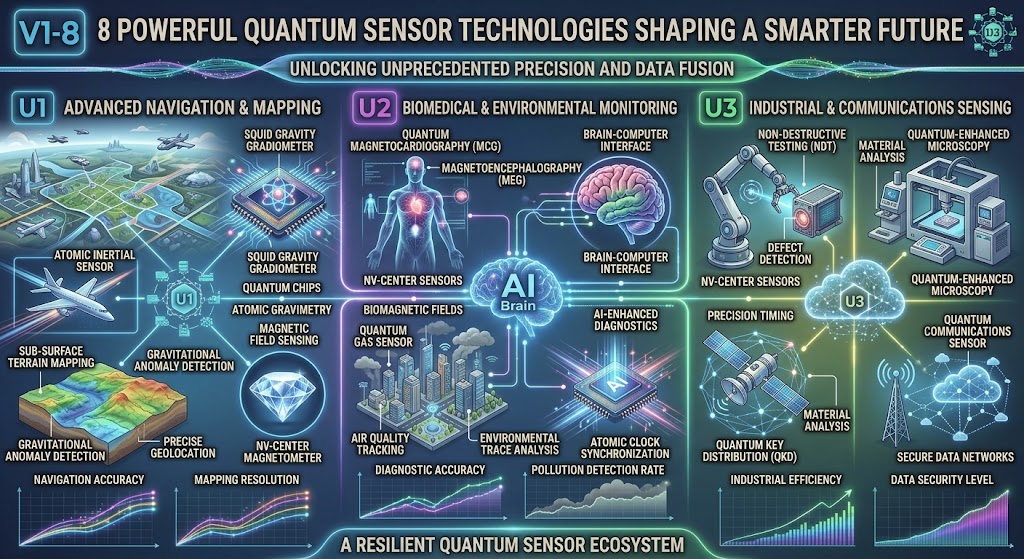
The goal is not simply to make conventional sensors smaller. Quantum sensing can provide fundamentally different ways of measuring the world. In some applications, this can reveal extremely weak signals or tiny changes that are difficult to detect using traditional sensing technologies.
Why Quantum Sensor Technologies Matter
The importance of Quantum Sensor Technologies comes from their potential to improve measurements in situations where even small errors can matter. Navigation systems, geological surveys, medical research, scientific experiments, and environmental monitoring can all benefit from highly precise sensing.
For example, a highly sensitive magnetic sensor could help researchers study biological signals or materials, while a gravity sensor could potentially help map underground structures. These possibilities are encouraging researchers to develop quantum sensors that are more compact, reliable, and easier to operate outside specialized laboratories.
1. Quantum Magnetic Sensor Technologies
Quantum magnetic sensing is one of the major areas of Quantum Sensor Technologies. These sensors can detect very small magnetic fields by using quantum properties of atoms, electrons, defects, or other quantum systems.
Magnetic sensing has applications in scientific research, materials analysis, navigation, and biomedical studies. Researchers are particularly interested in sensors that can detect weak magnetic signals without requiring large equipment. As these systems become more practical, quantum magnetic sensors could support increasingly precise measurements in laboratories and specialized devices.
2. Quantum Gravity Sensor Technologies
Quantum gravity sensors are designed to measure extremely small variations in gravitational fields. These variations can contain useful information about the density and structure of objects beneath the Earth’s surface.
This makes gravity sensing interesting for geological research, infrastructure studies, underground mapping, and scientific exploration. Future systems could potentially identify changes in underground structures without relying entirely on conventional drilling or excavation methods.
3. Quantum Inertial Sensor Technologies
Another important area of Quantum Sensor Technologies is quantum inertial sensing. These systems can measure acceleration and rotation with extremely high precision, making them potentially valuable for navigation.
Traditional navigation systems often depend on satellite signals or conventional inertial sensors. Quantum-based systems could provide another way to maintain accurate positioning when satellite signals are unavailable or unreliable. This could be particularly relevant to aircraft, ships, autonomous systems, and scientific instruments.
4. Quantum Time and Atomic Sensor Technologies
Accurate time measurement is essential for modern communication, navigation, scientific research, and computing. Atomic clocks already provide extremely precise timekeeping, and advanced quantum technologies continue to improve the possibilities for compact and highly accurate timing systems.
Modern communication networks depend on synchronized timing, while satellite navigation also relies heavily on precise clocks. More advanced atomic and quantum timing technologies could improve synchronization and support future navigation and communication systems.
5. Quantum Imaging Sensor Technologies
Quantum imaging is another fascinating direction within Quantum Sensor Technologies. Instead of simply capturing ordinary images, quantum imaging systems can use quantum properties of light to obtain information in specialized ways.
Researchers are investigating quantum imaging for scientific measurement, low-light environments, microscopy, and other applications. Some techniques can extract useful information from very limited light levels, although practical performance depends strongly on the specific technology and environment.
6. Quantum Temperature Sensor Technologies
Temperature measurement may also benefit from quantum sensing. Quantum systems can respond to changes in their environment, allowing researchers to develop highly sensitive methods for detecting temperature variations.
Highly precise temperature measurements can be valuable in physics experiments, advanced manufacturing, semiconductor research, and other scientific environments. The long-term goal is to develop sensors that combine quantum-level sensitivity with practical size, stability, and operating conditions.
7. Quantum Sensors for Environmental Monitoring
Environmental monitoring is another promising application of Quantum Sensor Technologies. Extremely sensitive sensors could potentially detect subtle changes in magnetic, gravitational, chemical, or physical conditions.
In the future, quantum sensing systems could support research into geological activity, atmospheric conditions, water resources, and other environmental processes. Their value would come from the ability to detect small signals that can provide information about changes in complex natural systems.
8. Quantum Sensor Technologies for Healthcare
Healthcare research is also exploring the potential of Quantum Sensor Technologies. Extremely sensitive magnetic and imaging sensors could help researchers investigate biological signals and understand physiological processes.
One example is the measurement of very weak magnetic signals generated by biological activity. Quantum sensors may offer researchers new tools for studying these signals with high sensitivity. However, many medical applications remain an active area of research and require extensive validation before becoming routine clinical technologies.
Quantum Sensor Technologies Comparison
| Quantum Sensor Technology | What It Measures | Potential Application | Main Advantage |
|---|---|---|---|
| Quantum magnetic sensors | Magnetic fields | Biomedical research | High sensitivity |
| Quantum gravity sensors | Gravity variations | Geological mapping | Detects subtle density changes |
| Quantum inertial sensors | Acceleration and rotation | Navigation | Precise inertial measurement |
| Atomic time sensors | Time and frequency | Communication | Exceptional timing precision |
| Quantum imaging sensors | Light and spatial information | Scientific imaging | Specialized low-light capabilities |
| Quantum temperature sensors | Temperature changes | Research and manufacturing | Highly sensitive measurement |
| Environmental quantum sensors | Physical environmental signals | Monitoring | Detection of subtle changes |
| Biomedical quantum sensors | Biological signals | Healthcare research | Sensitive signal detection |
Quantum Sensor Technologies and Future Industries
The potential impact of Quantum Sensor Technologies extends beyond one industry. In transportation, precise inertial sensing could contribute to advanced navigation systems. In geology, gravity sensing could provide new information about underground structures. In healthcare research, highly sensitive magnetic measurements could help scientists study biological activity.
The technology could also become important in scientific research because many experiments require measurements of extremely weak signals. A sensor that can detect tiny changes may allow researchers to investigate phenomena that are difficult to observe with conventional equipment.
Illustrative Quantum Sensor Technology Areas
The following chart is an illustrative comparison of technology areas, not a market-size ranking or measured performance score:
Challenges Facing Quantum Sensor Technologies
Despite their potential, Quantum Sensor Technologies face several important challenges. Quantum systems can be highly sensitive not only to the signal researchers want to measure but also to unwanted environmental effects. Temperature changes, vibration, electromagnetic interference, and other disturbances can affect performance.
Another challenge is size and complexity. Some quantum sensors require specialized equipment, controlled environments, or sophisticated measurement systems. Turning laboratory demonstrations into compact, affordable, reliable products remains a major engineering goal.
Cost is another consideration. Advanced quantum devices can require specialized materials, precision components, and complex control electronics. Continued progress in manufacturing and miniaturization will be important for bringing quantum sensing into more practical applications.
The Future of Quantum Sensor Technologies
The future of Quantum Sensor Technologies will depend on improvements in quantum materials, photonics, atomic systems, miniaturized electronics, and artificial intelligence. Researchers are working toward sensors that can operate outside controlled laboratory environments while maintaining useful levels of precision.
One important trend is miniaturization. Smaller quantum sensors could eventually be integrated into vehicles, scientific instruments, industrial equipment, and portable devices. If this happens, quantum sensing could move from highly specialized research environments into a much wider range of real-world applications.
Another possibility is combining quantum sensors with AI. Machine-learning systems could help interpret complex sensor data, identify patterns, and compensate for environmental noise. This combination could make advanced sensing systems easier to use in practical environments.
Conclusion
Quantum Sensor Technologies are transforming the way researchers think about measurement by using quantum effects to detect extremely small physical changes. From magnetic and gravity sensing to inertial navigation, atomic timing, imaging, environmental monitoring, and healthcare research, these technologies could influence many areas of science and engineering.
Although challenges involving cost, stability, miniaturization, and environmental interference remain, continued research is making quantum sensing increasingly practical. As these systems become smaller and more robust, Quantum Sensor Technologies could play an important role in shaping a smarter future built around more precise information and measurement.